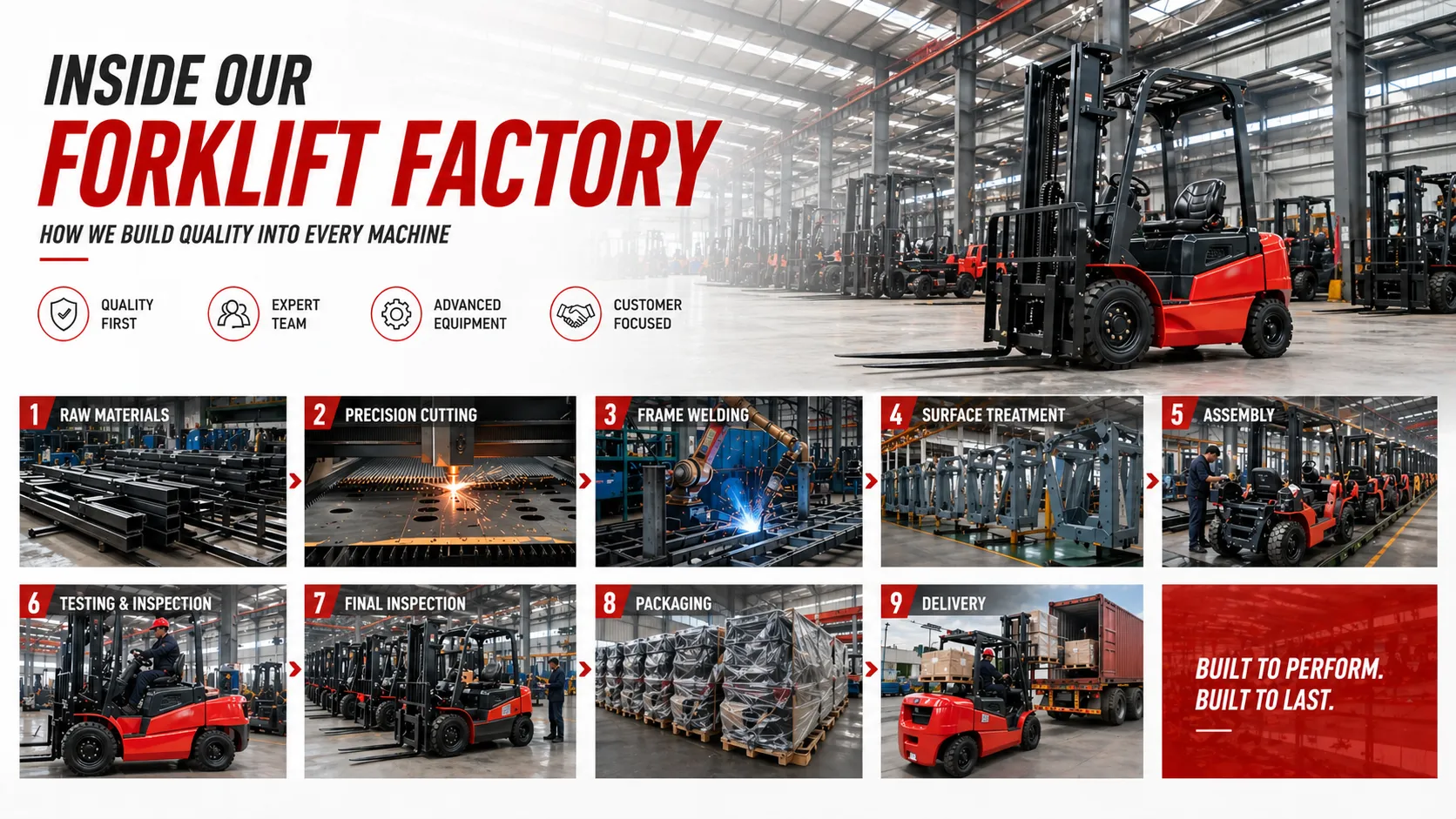
Every forklift that leaves our factory carries a story of raw materials transformed through precision, testing, and experience into a machine that will work for years in ports, warehouses, and construction sites around the world. We do not assemble forklifts from loosely inspected parts. We build them step by step, following a production system refined over years of serving demanding customers across Europe, the Middle East, Africa, and Southeast Asia. Let us show you how we build quality into every machine.
The process begins with raw materials. Every batch of high-strength steel for frames and masts is inspected upon arrival. We check thickness, strength, and surface quality. Substandard materials are rejected immediately. The same rigorous screening applies to every component, from engines and motors to hydraulic hoses and electronic controllers. Quality must be present from the very first step.
Once materials pass inspection, fabrication begins. Steel plates are cut, bent, and welded into chassis frames and mast sections. Every weld is visually inspected, with critical welds receiving additional testing. Structural components then move to our painting line, where shot blasting removes scale, followed by anti-corrosion primer and a durable top coat. This treatment allows our forklifts to operate outdoors in rain and humidity without premature rusting.
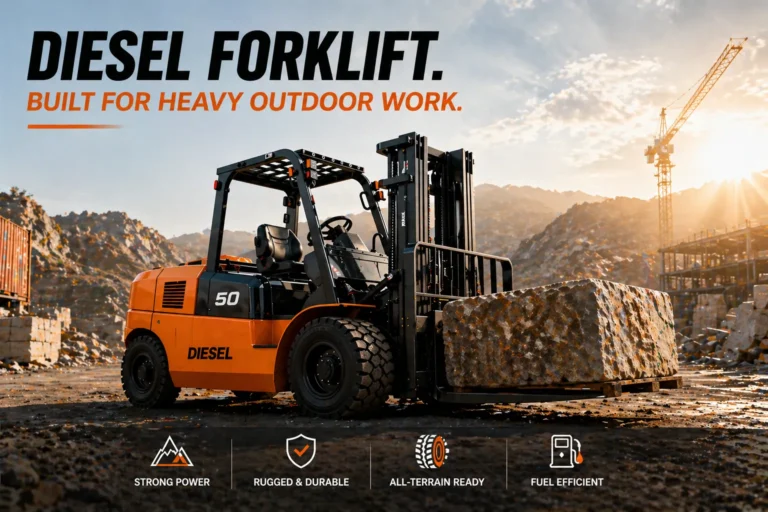
Assembly then begins on our dedicated production lines for diesel forklifts, electric forklifts, stackers, and pallet trucks. Each line follows written procedures, with torque values for every fastener specified and checked. Hydraulic lines are installed and tested for leaks. For diesel models, engines from Xinchai, Cummins, Kubota, and Isuzu are mounted and connected. For electric models, motors and controllers are installed with careful attention to wiring.
The heart of our quality system is the 108 production control points across all assembly lines. Each control point represents a specific check, measurement, or test that must be completed before the machine moves to the next stage. Every control point is documented, and any deviation triggers immediate review.
After assembly, every forklift must pass three rounds of final testing. The first is visual inspection, checking paint quality, labels, and fastener torque. The second is performance testing, measuring lift speed, travel speed, braking distance, and steering smoothness. The third is load testing, where each forklift is loaded to rated capacity and operated continuously while monitoring engine temperature, battery runtime, or emissions. The result is a product pass rate consistently above 99.8 percent. Any machine that fails any test is pulled from the line for rework. We do not ship units that do not meet our standards.
Once a forklift passes all testing, it moves to shipping. Standard models are ready within seven to ten working days after deposit confirmation, while custom orders take ten to fifteen working days. We partner with Maersk, MSC, and COSCO for efficient shipping to major ports worldwide. Our full product range holds CE, EAC, and SABER certifications, so you can export directly without additional compliance work.
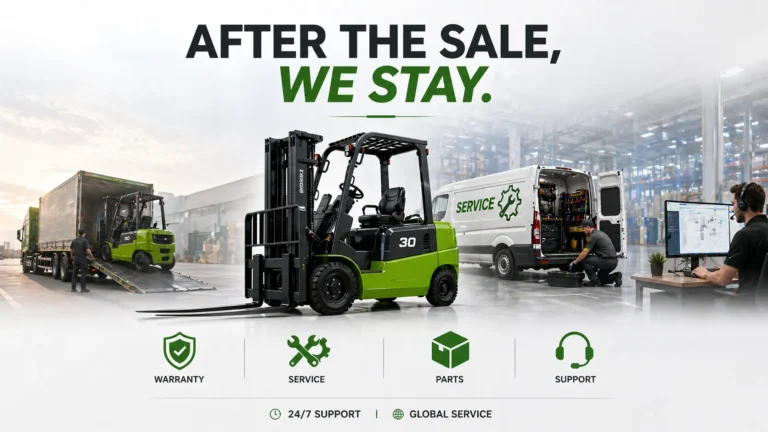
After your forklift arrives, our support continues. We provide 24/7 bilingual assistance, remote diagnosis within 24 hours, and spare parts dispatch within 48 hours. For customers in Southeast Asia, the Middle East, and Africa, we have local service points that maintain parts inventory and can perform on-site repairs.
This is how we build forklifts. Not quickly, not cheaply, but carefully, with checks at every step and a refusal to compromise on quality. If you are looking for a forklift supplier that takes production seriously, contact us. We are ready to build your next machine.